

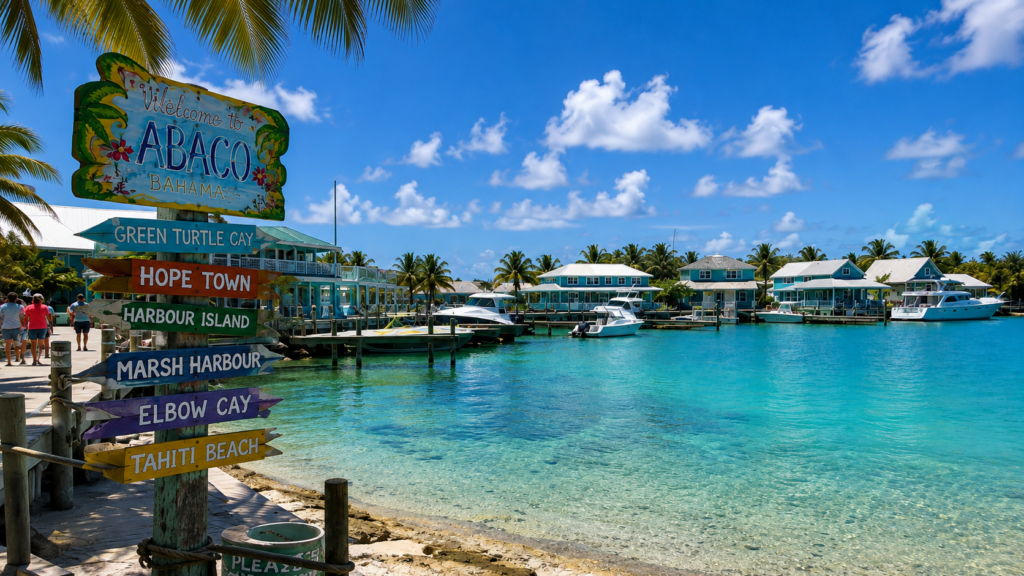
Most people who fly into the Bahamas never make it past Nassau. They land, they transfer to a resort, they spend four days on Cable Beach and go home. Abaco Island Bahamas sits about 190 miles north of Nassau, and the travellers who go there tend to come back with a different kind of trip in their memory: mornings on empty sand, afternoons on a boat, evenings in a village where the same six people wave at you every day.
This is not a nightlife island. It is not a mega-resort island. Abaco is a long chain of cays and mainland settlements where the pace drops the moment you leave the airport, and where the best days are usually the ones you did not plan.
If that sounds like your kind of holiday, here is what to actually expect.
What Abaco Actually Is
Before anything else, it helps to understand that Abaco is not one place. It is a collection of them.
The mainland, sometimes called Great Abaco, runs roughly 120 miles north to south. Marsh Harbour sits near the middle and functions as the commercial centre, with the main airport, grocery stores, marinas, and most of the island’s services. Treasure Cay lies to the north. Sandy Point and the deep south are quieter still.
Then there are the cays, a string of small islands running parallel to the mainland’s eastern shore, separated from it by the Sea of Abaco. Elbow Cay, Green Turtle Cay, Man-O-War Cay, Great Guana Cay, and Little Harbour each have their own character. Most are reachable only by ferry or private boat, and several have almost no cars at all.
Understanding this geography matters more here than on most islands, because your choice of base determines how your entire week feels.
| Base | Best For | Getting Around | Trade-off |
| Marsh Harbour | First visits, families, convenience | Rental car or car service | Least atmospheric |
| Elbow Cay (Hope Town) | Couples, walkers, photographers | Golf cart, on foot | Ferry-dependent |
| Green Turtle Cay | Slow travel, quiet beaches | Golf cart, boat | Farthest from airport |
| Treasure Cay | Beach-first travellers | Car or cart | Fewer dining options |
| Great Guana Cay | Snorkelling, beach bars | Cart, boat | Limited services |
The table simplifies a lot, but the pattern holds. Marsh Harbour is where you sleep if you want a supermarket. The cays are where you sleep if you want the trip you imagined.
The Beaches Are the Point
Abaco’s beaches do not need much selling, but they do need some context.
Treasure Cay Beach is the one that shows up in photographs: a long crescent of pale sand on the northern mainland, shallow and calm, with a gradual slope that makes it genuinely usable for small children. It gets busier than most Abaco beaches, which in practice means you might see thirty people instead of three.
Tahiti Beach, at the southern tip of Elbow Cay, is a different proposition entirely. It is a sandbar that appears and disappears with the tide. At low water it becomes a wide flat of ankle-deep clear water with a stand of palms at one end. At high water, much of it is gone. Getting there means either a boat, a long golf cart ride, or a walk, and the effort is part of why it stays quiet.
Guana Cay’s ocean side runs for miles with almost nobody on it. Coco Bay on Green Turtle Cay is small, sheltered, and good for swimming. Pelican Cays Land and Sea Park, south of Marsh Harbour, protects a set of reefs and cays that you reach by boat and where the snorkelling is the reason you came.
A few things worth knowing about beach days here:
- There are almost no facilities on most beaches. Bring water, bring shade, bring your own food.
- Sandflies are real, particularly at dawn and dusk on the leeward sides. Repellent matters more than sunscreen at those hours.
- Tide charts genuinely change your plans. Tahiti Beach at the wrong tide is a swim, not a beach.
- Very few beaches have lifeguards. Currents around cuts between cays can be strong.
None of this is a warning. It is the price of admission for beaches that are not managed, developed, or crowded.
Getting to Abaco and Getting Around
Arrival logistics shape the first day of any Abaco trip, so it is worth thinking through before you book.
Flying In
Marsh Harbour International Airport is the main entry point, with the code MHH. There are direct flights from several US cities, and connecting flights through Nassau on domestic carriers. Treasure Cay Airport, TCB, serves the north and is smaller.
If you connect through Nassau, you are dealing with two arrivals in one day. That connection is where trips most often go wrong: a delayed inbound flight can mean a missed domestic hop, and the last ferries to the cays run in the early evening. Build a buffer, or plan to overnight in Nassau and continue in the morning.
From the Airport to Your Base
Marsh Harbour airport sits a short drive from town, and roughly 15 to 20 minutes from the ferry docks depending on which dock your cay uses. This is where Bahamas airport transfers stop being an abstract question and start being a real one, because if you are catching a ferry with luggage and a schedule, the drive matters.
Your options break down like this:
- Rental car. Sensible if you are staying on the mainland and want to explore Great Abaco. Pointless if you are heading to a cay, since you will park it and not touch it.
- Pre-arranged car service. The cleanest option for ferry connections. A driver who knows the ferry schedule and is waiting when you land removes the single biggest failure point in an Abaco arrival. Abaco transportation car service is worth arranging in advance rather than sorting on the ground, because taxi supply at MHH thins out quickly after a flight clears.
- Taxi. Available, but availability depends on flight timing.
For travellers who are landing in Nassau first and continuing north the next morning, the same logic applies at both ends of the journey. A pre-booked private transfer means no queueing at the kerb and no fare negotiation after a long travel day, which is the sort of thing that matters more at 9pm with two suitcases than it does when you are planning from your sofa. Simon’s Transports handles this kind of Bahamas airport to resort transportation across Nassau and the Out Islands, which is useful when your itinerary crosses more than one island in a day.
Getting Around Once You Arrive
On the mainland, you need a car. Distances are real, and there is no meaningful public transport.
On the cays, you mostly do not. Hope Town on Elbow Cay bans cars in the historic settlement. Man-O-War Cay is golf carts and bicycles. Green Turtle Cay’s New Plymouth is walkable end to end in fifteen minutes. Golf cart rental is the standard, and booking one in advance during high season is not optional if you want to have one.
Ferries between the mainland and the cays run on published schedules that change seasonally. They are the backbone of the whole system, and locals plan their days around them.
The Slow Travel Case for Abaco
Here is the part that does not fit neatly into a listicle.
Abaco rewards doing less. The islands are set up for it, and the traveller who arrives with a packed itinerary tends to spend the week frustrated by ferry times and weather. The traveller who arrives with one plan per day tends to have a better trip.
A good Abaco day looks like this: coffee somewhere with a view of water, a boat or a cart to somewhere quiet, several hours of nothing in particular, a late lunch at a place with picnic tables, a swim, and a slow evening. That is the whole thing. There is no attraction to tick off.
The settlements themselves reward the same approach. New Plymouth on Green Turtle Cay is a grid of colonial-era clapboard houses, loyalist history, and a very small museum. Hope Town has a candy-striped lighthouse, still manually operated, and streets narrow enough that you understand immediately why cars were never allowed. Man-O-War Cay has a boatbuilding tradition that predates most of what is around it, and if you walk into the right shed at the right time, someone will explain it to you.
You do not book any of that. You walk into it.
Boating, Fishing, and What Happens on the Water
Water is the real infrastructure of Abaco, and most of what people remember about their trip happened on it.
Bonefishing and the Marls
The Marls, a vast area of shallow flats and mangrove creeks on Abaco’s western side, are one of the reasons anglers know this island. It is bonefishing water, and it is fished from skiffs with a guide poling you across flats where you are sight-casting to fish in a foot of water.
This is not casual fishing. It is technical, it is frustrating for beginners, and people build entire holidays around it. Guides book out well in advance in the good months, and going with a guide is not a luxury here, it is the only sensible way to fish water that complex.
Offshore, the deeper water off Abaco’s eastern edge produces the usual pelagic species, and charters run out of Marsh Harbour and several of the cays.
Boat Rental and Island Hopping
Renting a boat is very normal in Abaco, and for many visitors it is the single decision that transforms the trip. A small centre console gives you access to sandbars, reefs, beach bars, and cays that no road reaches.
Some honest caveats:
- The Sea of Abaco is protected and generally calm, but it is not a swimming pool. Wind matters.
- Navigation here is visual. You read water colour to avoid coral heads and shallows. If you have never done that, take the orientation seriously.
- Fuel, ice, and provisions come from a small number of places. Plan the day around them.
Snorkelling and Diving
Fowl Cay Preserve and Pelican Cays Land and Sea Park protect reef systems that are shallow enough to snorkel and healthy enough to be worth the boat ride. Mermaid Reef, just off Marsh Harbour, is accessible from shore and works well for a first look or for kids.
Dive operators run from Marsh Harbour and cover blue holes, wrecks, and reef sites. The visibility on a calm day is the kind that makes people take up diving.
Where to Eat and What to Expect
Dining in Abaco is smaller and more improvisational than in Nassau, and that is worth setting expectations around.
Nippers on Great Guana Cay is the island’s most famous beach bar, perched above the ocean beach, and its Sunday pig roast has been a fixture for decades. Grabbers, on the other side of the same cay, does sunsets. Pete’s Pub at Little Harbour is a bar and a bronze foundry in the same place, which is not a sentence you write about many restaurants.
On the mainland, Marsh Harbour has the widest range, including waterfront places at the marinas. Hope Town has a handful of small restaurants and a bakery that people plan their mornings around.
Practical realities:
- Many places close on specific days, and hours shift by season. Call ahead.
- Menus depend on what came off the boat. Conch, grouper, and lobster in season are the reliable answers.
- Cash is useful. Card acceptance is not universal on the smaller cays.
- Reservations matter at dinner in high season, in restaurants with eight tables.
Lobster season traditionally runs from August through the end of March, which means an autumn or winter visit puts it on menus. Verify current dates with local operators, since regulations can shift.
When to Go
Timing changes the Abaco experience substantially, and there is no single right answer.
Late autumn through spring is the settled season: lower humidity, calmer water, reliable ferry schedules, and full restaurant hours. This is also when the island is busiest and accommodation prices peak.
Summer is hot, quiet, and cheap, with more chance of afternoon squalls. Hurricane season officially runs June through November, with the historical peak in late summer and early autumn. Many visitors avoid that window entirely, and travel insurance is a genuine consideration rather than an upsell.
Autumn and early winter bring the calendar to life. Abaco’s settlements hold their own events, and Junkanoo parades take place across the Bahamas each year in late December, with rushes in the early hours and a scale that surprises first-time visitors. Regatta Time in Abaco is a long-standing sailing series held in the summer months. Schedules for all of these shift, so confirm dates with the official organisers before booking around them.
Practical Notes Worth Knowing
A short list of things that regularly catch first-time visitors off guard.
- Hurricane Dorian. The 2019 storm hit Abaco directly and hard. Recovery has been substantial but uneven, and you will see the difference between settlements. It is part of the island’s recent history and worth reading about before you go.
- Cash. ATMs exist in Marsh Harbour and are scarce elsewhere. US dollars are accepted alongside Bahamian dollars at par.
- Groceries. Marsh Harbour has real supermarkets. The cays have small stores with limited stock and higher prices. Provision before you cross.
- Connectivity. Mobile coverage is good in the main settlements and patchy in between. Wi-Fi at accommodation varies.
- Medical. There is a clinic in Marsh Harbour. Serious cases go to Nassau or Florida. This is a genuine argument for insurance.
- Sun. The reef sun is stronger than it feels on a breezy boat. People get burned on day one and lose day two.
Who Abaco Is Not For
Worth saying plainly, because a mismatched traveller has a bad week here.
If you want nightlife, casinos, big resorts with five restaurants, spa complexes, or a schedule of organised activities, Nassau and Paradise Island do that far better and you should go there instead. If you need everything to run on time, the ferry-and-weather rhythm will grate. If you have never been comfortable with quiet, four days of it can feel long.
Abaco is for people who are happy on a boat, happy on a beach with no bar, and happy to have the same conversation with the same shopkeeper every morning. That is a real category of traveller, and Abaco is close to the best version of what they want.
Frequently Asked Questions
Do you need a car in Abaco?
It depends entirely on where you stay. On the mainland, including Marsh Harbour and Treasure Cay, a rental car or a pre-arranged Abaco transportation car service is necessary because distances are long and there is no public transport. On the cays, most visitors use golf carts, bicycles, or walk, and Hope Town restricts cars in the historic settlement altogether. If you are heading straight to a cay, a rental car will sit unused.
What is the best time of year to visit Abaco?
Late autumn through spring offers the most settled weather, calmer water, and the fullest restaurant and ferry schedules, though it is also the busiest and most expensive period. Summer is hotter and quieter with lower prices and a higher chance of afternoon storms. Hurricane season officially runs from June through November, with the historical peak in late summer and early autumn. Many visitors weigh the savings of a summer trip against the risk and take travel insurance seriously.
Is Abaco good for families with young children?
Yes, particularly if you base yourself somewhere with a calm, shallow beach. Treasure Cay Beach has a gradual slope and settled water that suits small children well. The trade-off is that most beaches have no facilities, few have lifeguards, and medical care beyond a clinic means a flight to Nassau or Florida. Families who plan around those realities generally find Abaco easier than a large resort, not harder.
How far is Marsh Harbour airport from the ferry docks?
The drive is short, generally in the range of 15 to 20 minutes depending on which dock serves your cay and on traffic through town. Because ferries run to a schedule and stop in the early evening, that drive is the point where a delayed flight turns into a missed connection. Arranging Bahamas airport transfers in advance, with a driver who knows the ferry timetable, removes most of that risk. Confirm current ferry times with the operator before you travel, as they change by season.