

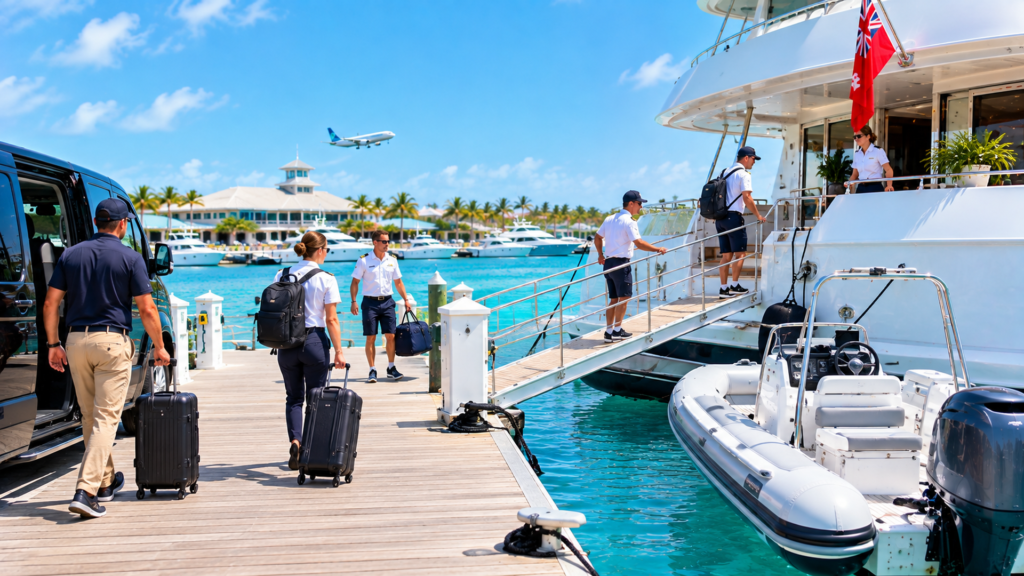
Every experienced captain knows the day a port call goes wrong is rarely the day something dramatic happens. It is the day a joining crew member gets held at immigration over a missing return ticket, the provisioning run comes back an hour late with the cold chain broken, and the whole thing eats into a weather window that was already tight.
Yacht crew transportation Nassau is not really about vehicles. It is about protecting the departure. A boat in Nassau generates a web of ground movements, crew joining and leaving, supplies coming aboard, guests arriving, and every one of them is a thread that can snag on the same fixed point: the moment the boat is meant to slip lines. This guide is the operational layer that sits above whichever marina you are tied up at, whether that is Hurricane Hole on Paradise Island, Albany on the southwest coast, or Lyford Cay on the western tip. The dock-specific detail lives in the individual marina guides. This is the logic that holds across all of them.
Start From the Departure Window, Not the Arrival
The mistake that structures most crew logistics problems is planning forward from arrivals instead of backward from the departure, so it is worth fixing the frame first.
A charter or owner’s trip has a departure moment, and that moment is often soft. It moves with weather, with fuel timing, with the owner’s plans, with a delayed guest flight. Everything on the ground, the crew change, the provisioning, the guest arrivals, has to be complete before that moment, with enough margin that a single delay does not cascade into the window closing.
Planning from the departure backward changes the questions. Not “when does the joining stew land” but “how late can she land and still be aboard, cleared, and working before we need to leave.” Not “when is the provisioning run” but “what is the last moment the cold goods can come aboard and still be stowed before departure.”
That backward frame is what separates a port call that runs and one that scrambles. Every movement below is timed against the window, not against its own convenience.
The Crew Change Immigration Trap
This is the single detail most likely to derail a crew change, and it catches experienced people, so it goes near the top.
A crew member who flies into Nassau to join a vessel and then leaves the Bahamas by sea is in an unusual immigration position. Bahamas Immigration expects arriving air passengers to hold a return air ticket. A crew member who arrives on a one-way ticket, intending to depart on the boat, does not fit the normal pattern, and this is where people get held.
The verified guidance is specific. A joining crew member arriving by plane and departing by boat should carry a copy of the vessel’s cruising permit, because their name appears on the manifest, and a letter will not suffice as a substitute. The common precaution is to buy a refundable or throwaway return air ticket and seek reimbursement later, so there is a return ticket to show, even though the actual departure is by sea.
For the captain or purser, this means the crew change paperwork is not just a flight booking. Before a joining crew member travels, confirm they have proof of onward travel that satisfies immigration, and that the vessel’s documentation supports their entry. This is arranged before they fly, not fixed at the immigration desk in Nassau.
Crew Changes: The Airport Half
Once the paperwork is right, the physical crew change is a transport problem, and it has its own rhythm distinct from guest movements.
Crew change Nassau movements happen on airline schedules, which means they rarely land at convenient hours and often cluster when a rotation brings several people in or out on the same day. The joining crew need to get from the airport to the boat. The departing crew need to make their outbound flights with the airport buffer that international departures demand.
A few operational points that hold regardless of marina:
- Crew arrive tired and off-schedule. A pre-arranged vehicle tracking the flight beats a kerbside negotiation at midnight.
- A rotation moving several people is a coordination task, not a set of separate rides. One operator holding the whole rotation keeps the handoffs from dropping.
- Departing crew need the full international departure buffer, two to three hours, plus the drive, timed backward from the flight.
- The airport-to-dock drive time varies enormously by marina, from a short western-side run to a cross-island haul to Paradise Island. Know yours and build it in.
The drive itself is where the marina you are tied up at matters most, and the individual marina guides carry the specific distances and gate procedures. The crew-change discipline above is the same wherever you are docked.
Provisioning as a Discipline
Provisioning is where a mate’s day actually goes, and treating it as a discipline rather than a series of shopping trips is what keeps it from breaking the schedule.
Provisioning Nassau for a yacht is not one errand. It is a sequenced operation across multiple suppliers: the main provisioning shop for volume, specialist stops for particular food and drink, the chandlery or parts run, pharmacy, and the crew’s own errands. Some of this is available at or near the marina, more so at the larger developments, and the serious volume is at the full-size supermarkets and suppliers concentrated in the Nassau area.
The discipline is in how the run is structured.
| Principle | Why It Matters |
| Book vehicle time, not trips | Multiple stops with a waiting driver beats summoning a ride at each one |
| Size to the return load | A full provisioning run fills a van; crew going out is not the measure |
| Sequence cold goods last | Refrigerated and frozen items should be the final stop before the dock |
| Protect the cold chain | A waiting vehicle, not a kerbside wait, is what keeps frozen goods frozen |
| Use dockside services first | On-property provisioning and on-deck delivery reduce what has to be fetched |
The cold chain point is the one that turns into a real problem when ignored. A provisioning run that finishes with frozen goods sitting at a kerb while a ride is summoned is a run that arrives back with spoilage, and on a boat about to depart there is no time to replace it.
A driver who knows the Nassau suppliers, which ones have workable loading, where the specialist stops actually are, saves more time on a provisioning run than the driving does. This is local operational knowledge, and it is worth more to a mate under time pressure than a nicer vehicle.
Tender or Dock: A Real Decision
Not every crew or supply movement starts at a dock, and the tender-versus-dock question is a genuine operational choice worth making deliberately.
A boat on a berth moves people and supplies by vehicle to and from the dock directly. A boat at anchor or on a mooring moves them by tender to a landing, then by vehicle, which adds a leg, adds timing dependency, and adds a point where a schedule can slip. The tender run has to align with the vehicle, and the vehicle has to align with the flight or the supplier, and each handoff is a place to lose time.
For a crew change or a provisioning run on a boat that is not alongside, the tender leg is part of the transport plan, not separate from it. The vehicle should be timed to the tender, the tender to the movement, and the whole chain backward from the departure window. Losing a tender, missing the landing, mistiming the pickup, is exactly the kind of small failure that the title of this piece warns about, and it comes from treating the tender leg as an afterthought rather than a scheduled link.
Where the boat can go alongside for the crew change and the main provisioning, doing so removes a leg and its risk. That is often worth arranging even for a short stay, precisely because it simplifies the ground chain.
Guests and Crew in the Same Window
When a charter guest arrival overlaps with a crew change, the two have to be coordinated, and treating them as one problem rather than two is what keeps them from colliding.
Guests arriving to join the boat and crew rotating in or out often land in the same window before a departure, sometimes at the same airport within the same hour. Managing these separately, with different drivers who do not know about each other, is how a guest ends up waiting while a vehicle is committed to a crew run, or a crew member is late because the vehicle was held for a guest.
A single operator holding the boat’s whole ground schedule handles the guest arrivals against their flight numbers, the crew rotation against theirs, and the provisioning blocks against the departure, and adjusts the whole set when the window moves. Captain logistics Bahamas at this level is coordination more than transport, and the value of one point of contact is that a shifting departure means one conversation, not five.
Simon’s Transports has run this kind of yacht and crew coordination across Nassau, Paradise Island, and the western marinas for over thirty years, with a fleet spanning sedans, SUVs, sprinters, and buses, which for a captain matters less as a vehicle list than as the ability to put the right vehicle against each thread of an overlapping schedule and hold the timing across all of them.
What the Marina Handles, and What You Still Have to Run
Some of the logistics load is carried by the marina, and knowing the split prevents both duplicated effort and dangerous assumptions.
Several Nassau-area marinas are designated ports of entry with on-site customs and immigration clearance, which handles the vessel’s arrival formalities dockside. Only the captain may leave the boat until the vessel is cleared, and the yellow quarantine flag flies until then, so the clearance is a gating step before any crew movement ashore begins. Some marinas work with local agents to smooth the process. In-slip fuelling, dockside provisioning, and on-deck delivery cover a portion of what would otherwise be ground runs.
What the marina does not handle is the airport chain, the off-property provisioning volume, and the crew’s movements to and from flights. Those are the captain’s or purser’s to run, and they are the ones timed against the departure window.
The practical division: clearance, fuelling, and a share of provisioning are dockside and marina-supported. Crew changes, guest arrivals, and full provisioning are ground logistics that need arranging and coordinating, and they are where a port call is won or lost on timing.
Timing, Season, and the Things That Move the Window
A few external realities push on the departure window from outside, and a captain planning a Nassau port call should have them in view.
Cruise ship days congest downtown Nassau and the routes that pass through it, which stretches any ground movement crossing the centre of the island, including some airport runs and most provisioning runs to the main suppliers. A crew change or supply run timed tight on a heavy cruise day needs extra margin. Marinas on the western side of the island, with airport runs that avoid downtown, are less exposed to this than the Paradise Island marinas.
The winter high season, late autumn through spring, is the busiest period on the water and around the island, with settled weather and full activity ashore. Summer is quieter, and hurricane season officially runs June through November with its historical peak in late summer and early autumn, which for a working vessel is a scheduling reality that pushes on departure windows directly.
The Bahamas events calendar occasionally closes or reroutes downtown roads, affecting ground movements through the centre. Junkanoo parades take place across the islands each year in late December, with rushes in the early hours. A captain with a port call around a major event should confirm current dates and any road closures with the official organisers, since routes and timings shift and a closed road can strand a provisioning run.
A Pre-Port-Call Checklist for the Captain or Purser
Before a Nassau port call that involves crew changes and provisioning, working through this protects the departure window.
- Fix the departure window first, and time every ground movement backward from it.
- For joining crew arriving by air and leaving by sea, confirm they carry proof of onward travel that satisfies immigration and a copy of the cruising permit with their name on the manifest.
- Confirm the vessel’s clearance status and that the marina is a designated port of entry, since no crew moves ashore until the boat is cleared.
- Book crew airport runs against flight numbers, and coordinate a multi-person rotation as one operation.
- Structure provisioning as vehicle time with a waiting driver, sequenced so cold goods come aboard last.
- If the boat is not alongside, build the tender leg into the ground chain and time it deliberately.
- Coordinate overlapping guest arrivals and crew changes through one point of contact.
- Know your marina’s airport drive time and whether the route crosses downtown.
- Build extra margin for any movement on a heavy cruise day or around a major event.
That list turns a Nassau port call from a set of independent scrambles into a single coordinated operation timed against the one deadline that matters.
Frequently Asked Questions
How should a captain time crew changes and provisioning in Nassau?
Plan backward from the departure window rather than forward from arrivals. The departure moment is often soft, moving with weather, fuel, and guest timing, so every ground movement should be scheduled to complete before it with margin for a single delay. Ask how late a joining crew member can land and still be aboard and working, and what the last moment is for cold goods to come aboard and be stowed. This backward frame prevents one delay from cascading into a missed window.
What is the right way to handle yacht provisioning runs in Nassau?
Treat provisioning as a sequenced operation, not a series of trips. Book a vehicle for a block of time with a driver who waits at each stop, size the vehicle to the full return load rather than the crew heading out, and sequence the stops so refrigerated and frozen goods are collected last, closest to returning to the boat. Protecting the cold chain with a waiting vehicle rather than a kerbside wait is the point most often missed. Use dockside provisioning and on-deck delivery services to reduce what has to be fetched.
Does the marina handle customs clearance, or does the crew?
Several Nassau-area marinas are designated ports of entry with on-site customs and immigration clearance, which handles the vessel's arrival formalities at the dock. Until the vessel is cleared, only the captain may leave the boat and the yellow quarantine flag must fly, so clearance is a gating step before any crew go ashore. The marina does not handle the airport transfers, the off-property provisioning, or the crew's flight movements, which remain the captain's or purser's to arrange and coordinate against the departure window.
Why coordinate guest arrivals and crew changes together?
Guest arrivals and crew rotations often fall in the same window before a departure, sometimes at the same airport within the same hour, and managing them with separate drivers who do not know about each other leads to collisions, with a guest waiting while a vehicle is committed to a crew run or a crew member late because the vehicle was held. A single operator holding the whole ground schedule coordinates both against their flight numbers and the provisioning against the departure, and adjusts the entire set with one conversation when the window moves. That coordination is the core of crew logistics at this level.