

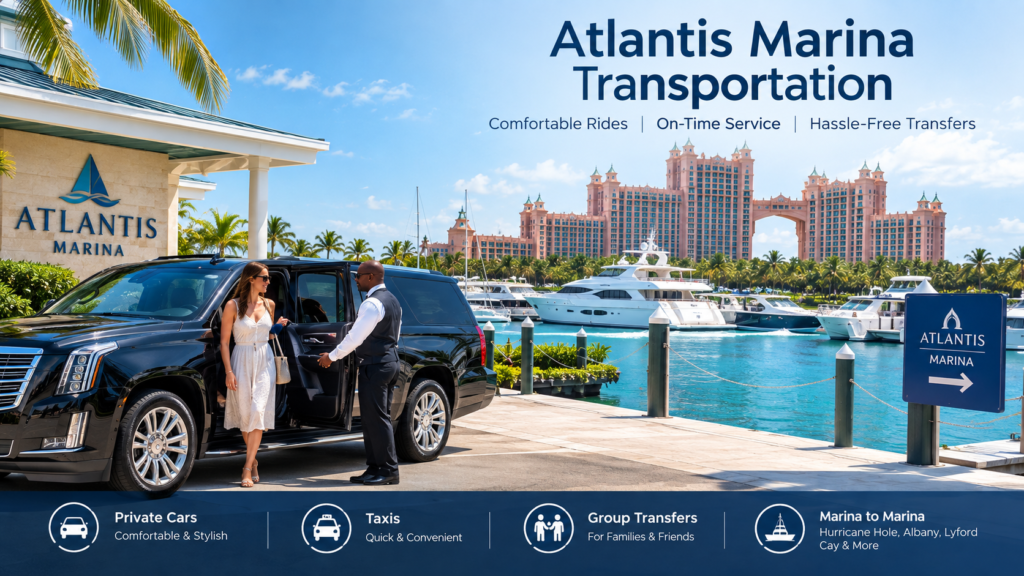
Atlantis Marina sits behind one of the largest resort complexes in the Bahamas, and that scale creates a transportation puzzle most first-time visitors don’t anticipate. Getting a boat full of guests, crew, and provisions from Lynden Pindling International Airport to the dock is only the first leg. Once you’re on Paradise Island, moving between the marina, the resort, and the rest of the property brings its own set of decisions.
Atlantis Marina transportation works differently depending on whether you’re a yacht guest arriving for a charter, a crew member handling provisioning runs, or someone meeting a boat after flying in separately from the rest of your party. This guide walks through each leg of the journey, from the airport to the dock, and then from the dock outward into Paradise Island itself.
Understanding Atlantis Marina Nassau And Its Layout
Atlantis Marina Nassau occupies the eastern side of the Atlantis resort property, positioned behind the main hotel towers and separate from the casino and beach areas most tourists associate with the resort. The marina operates as a full service superyacht harbor, with slips accommodating everything from sport fishing boats to large private yachts. Its position means guests arriving by vehicle need to navigate around, rather than through, the resort’s main entrance.
Marina Village sits directly adjacent to the docks and functions as a small shopping and dining strip built specifically for boat guests and marina visitors. This distinction matters for transportation planning because a driver told simply “Atlantis” might reasonably head for the hotel lobby or the casino entrance, both of which sit a considerable walk from the actual marina. Confirming the destination as the marina or Atlantis Marina Village specifically avoids this common mix-up.
Getting From The Airport To Atlantis Marina
The drive from Lynden Pindling International Airport to Atlantis Marina crosses the length of New Providence before reaching the bridge onto Paradise Island. Travel time typically runs somewhere between thirty and forty five minutes, though this stretches during peak arrival periods when several flights land close together. The route passes through downtown Nassau before crossing one of the two bridges connecting the mainland to Paradise Island.
Bridge traffic is the single biggest variable in this trip. Late afternoon and early evening tend to see the heaviest congestion, particularly during the winter charter season when cruise ships and international flights overlap in their arrival windows. A transfer scheduled with some buffer time built in holds up far better than one timed to the exact minute, especially if a captain is expecting the group before a specific departure.
A few practical points worth knowing about this leg of the trip:
- The marina has a dedicated arrival area separate from the hotel’s main entrance, and drivers should be told explicitly that the destination is the docks.
- Security checkpoints exist at the marina entrance, and yacht guests typically need to confirm a slip number or vessel name.
- Luggage volume matters more here than for a standard hotel drop-off, since dive gear, fishing equipment, and provisioning boxes take up considerably more space than carry-ons.
Yacht Guest Airport Pickup: What To Arrange In Advance
Yacht guest airport pickup for Atlantis Marina runs more smoothly when key details are settled before landing rather than sorted out at the curb. Most charter captains or yacht management companies coordinate this on behalf of guests, but travelers arranging their own transport benefit from having the same information ready. This includes the vessel name, slip number if known, and an estimated arrival time that accounts for immigration and baggage claim.
Groups arriving on different flights present a particular challenge. A family or charter party spread across two or three flights landing within a few hours of each other often finds it more efficient to book a single larger vehicle for a later pickup window rather than arranging separate transfers for each arrival. This reduces the coordination burden at the marina gate, where each vehicle typically needs its own security clearance.
Vehicle size deserves specific attention for this route. A group of four adults with standard luggage fits comfortably in a sedan, but the same group with dive bags, rod cases, or a week’s worth of provisions needs something larger. Requesting the right vehicle size at the time of booking, rather than discovering the mismatch at the airport curb, saves time and avoids the awkward scramble of fitting gear into a car that wasn’t built for it.
Moving Between The Dock And Paradise Island Marina Transfer Points
Once guests reach the marina, the next transportation question is how to move around Paradise Island itself. A Paradise Island marina transfer to the wider resort, whether for dinner reservations, casino visits, or beach access, typically involves either the resort’s internal shuttle system or a private vehicle, since walking distances across the property are longer than they appear on a map.
Marina Village itself is walkable from the docks, with restaurants, shops, and a small selection of services within a few minutes on foot. Reaching the main hotel towers, the water park, or the casino requires either a longer walk or a short ride, particularly for guests carrying dive gear or dressed for an evening out. The table below breaks down typical distances and transport needs across the property.
| Destination From Marina | Approximate Walking Time | Recommended Transport |
| Marina Village Shops and Restaurants | 5 to 10 minutes | Walking |
| Main Hotel Towers | 15 to 20 minutes | Resort shuttle or private vehicle |
| Casino | 15 to 20 minutes | Resort shuttle or private vehicle |
| Aquaventure Water Park | 20 to 25 minutes | Resort shuttle or private vehicle |
These estimates assume good weather and moderate foot traffic, both of which can vary considerably during peak season. Guests planning an evening at the resort after a full day on the water often find a scheduled vehicle more comfortable than the walk, particularly with children or after a long day in the sun.
Provisioning Runs And Crew Logistics
Crew members handling provisioning face a different set of transportation needs than arriving guests. Runs to grocery stores, marine supply shops, or liquor stores in downtown Nassau require a vehicle capable of handling both the trip out and the return with a full load of supplies. This is typically arranged separately from guest transfers, often with a vehicle booked for a several-hour window rather than a single point-to-point trip.
Timing these runs around bridge traffic makes a meaningful difference. Crew members who schedule provisioning trips for mid-morning, after the initial rush of guests but before afternoon congestion builds, tend to move through the route more efficiently than those attempting a supply run during peak hours. A pre-arranged private ride means there is no waiting at the terminal or negotiating fares at the curb, something particularly useful for crew making multiple trips in a single day.
Larger provisioning runs sometimes require more than one vehicle trip, particularly for extended charters stocking up for a week or more offshore. Coordinating this with a transport provider who understands marina access and can make repeat trips without needing new directions each time saves considerable back and forth compared to booking separate ad hoc rides.
Comparing Transfer Types For Atlantis Marina
Not every guest or crew member needs the same type of transfer. The right choice depends on group size, luggage volume, budget, and how tightly the arrival needs to align with a departure window.
- Private pre-arranged vehicles work best for guests with significant luggage, tight timing requirements, or groups large enough to need a dedicated vehicle.
- Airport taxi ranks suit smaller groups with standard luggage and flexible timing, though wait times can vary during busy arrival periods.
- Resort or charter-arranged transport often works well when a captain or yacht management company is already coordinating multiple guest arrivals.
Each option carries trade offs in cost, flexibility, and reliability. A group arriving with a tight connection to a departure tide benefits most from a pre-arranged vehicle that can adjust to flight delays, while a solo guest with a single bag has more flexibility to use whatever transport is available at the moment.
Weather Considerations For Marina Arrivals
Nassau’s weather shifts quickly, and this matters more for marina transfers than standard hotel drop-offs since boats and dock schedules are weather dependent. Sudden afternoon showers, common between May and October, can slow bridge traffic onto Paradise Island and add unexpected time to a transfer already running close to a departure window. Guests arriving during this period should check conditions the morning of travel rather than assuming clear skies will hold.
Winter charter season brings a different concern: stronger winds can affect dock conditions and loading procedures, particularly for larger vessels. Crew members should confirm with the marina office whether weather has affected slip assignments or arrival protocols before dispatching a transfer. A transportation provider familiar with the route can also advise on realistic timing when storms are moving through the area, which helps avoid a vehicle sitting at the marina gate waiting on a guest stuck in traffic caused by the same weather system.
First-Time Visitor Mistakes To Avoid
A few recurring mistakes cause unnecessary delays for guests using Atlantis Marina for the first time. Telling a driver only “Atlantis” without specifying the marina is the most common, since the resort’s main entrance and the dock area sit on opposite sides of the property. Assuming standard sedan capacity will handle dive bags, coolers, and provisioning boxes is another frequent miscalculation that leaves guests repacking at the curb.
Underestimating bridge traffic during peak arrival hours also catches people off guard, particularly those connecting straight from the airport to a tide-dependent departure. Booking a transfer without confirming the vessel name or slip number in advance can add friction at the marina’s security checkpoint as well. Avoiding these missteps mostly comes down to communicating specifics ahead of time, including destination, luggage volume, and timing, rather than leaving those details to be sorted out on arrival day.
Handling Delays And Schedule Changes
Flight delays are common enough during Nassau’s busy season that any transportation plan should build in some flexibility. A transfer scheduled to the exact minute of a flight’s listed arrival time rarely accounts for the reality of immigration lines, baggage claim, and the walk from the gate to the pickup area. Providers familiar with airport patterns typically build a buffer into their scheduling rather than dispatching a vehicle at the exact posted arrival time.
Communication matters as much as the buffer itself. A guest whose flight is delayed by an hour should notify their transfer provider as early as possible, ideally before landing if connectivity allows. This gives drivers time to adjust their schedule without leaving a vehicle waiting unnecessarily or, worse, missing the pickup entirely because the original timing no longer matched the flight’s actual arrival.
Frequently Asked Questions
Is Atlantis Marina the same location as the Atlantis hotel entrance?
No, Atlantis Marina has its own dedicated arrival area separate from the resort's main hotel entrance, and the two sit on opposite sides of a large property. Drivers unfamiliar with the resort sometimes head to the wrong entrance by default. Telling your driver specifically that you need the marina docks, not the hotel lobby, avoids this common mix-up.
How do I get from the marina to other parts of the Atlantis resort?
Marina Village is walkable from the docks in about five to ten minutes, but reaching the main hotel towers, casino, or water park generally requires a resort shuttle or a private vehicle given the longer distances involved. Walking is possible but takes fifteen to twenty five minutes depending on the destination. Most guests find a scheduled ride more practical, especially in the evening or with children in tow.
Can crew arrange separate transportation for provisioning runs?
Yes, provisioning runs are typically arranged separately from guest transfers, often booked for a several-hour window to allow for stops at grocery stores or marine supply shops. Scheduling these trips for mid-morning generally avoids the heaviest bridge traffic. Coordinating with a provider familiar with marina access makes repeat trips considerably more efficient.
What happens if my flight is delayed and I have a marina transfer booked?
Most transportation providers build some flexibility into airport pickups since delays are common during busy travel periods, but notifying the provider as soon as a delay is known helps them adjust their schedule accordingly. Providing updated flight information, ideally before landing, prevents a vehicle from being dispatched at the wrong time. Clear communication is generally more reliable than assuming a delay will be automatically accounted for.
What I love most about this platform is how welcoming it feels for new members. The welcome package gives you plenty of time to explore the catalog and test different strategies without pressure. Deposits go through in seconds and I never worry about hidden terms on the promotions. It is refreshing to find a site that actually puts player comfort first. nanocasinoonline