

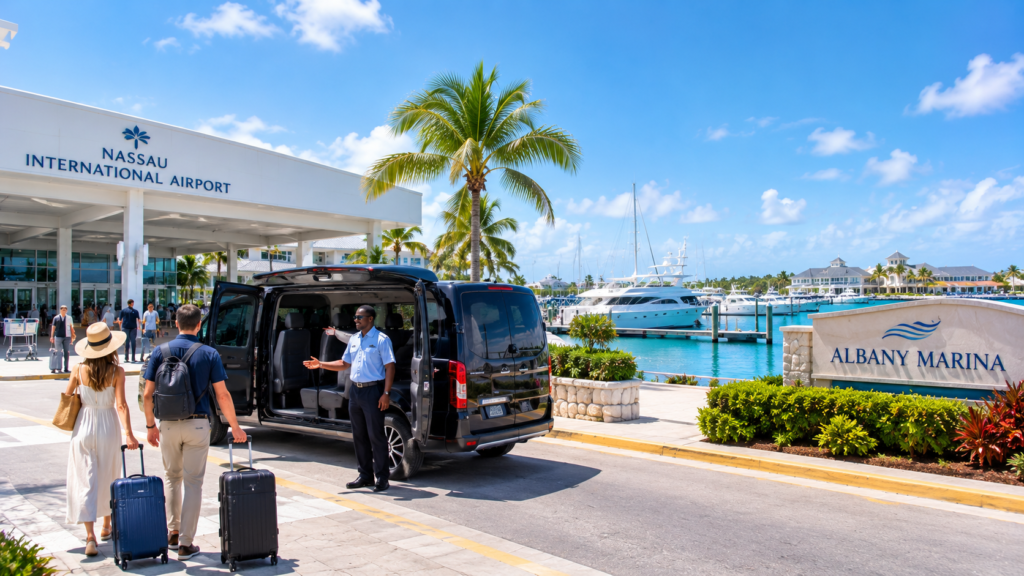
Most Bahamas marina arrivals involve a drive across the whole island. Albany Marina is the exception, and it is worth understanding why before you plan a single transfer.
Albany sits on the southwestern end of New Providence, on 600 oceanfront acres. Nassau’s airport sits on the western side of the island. That geography puts the marina unusually close to the airport, on the same side, with no need to cross downtown Nassau or a bridge to reach it. The slip listings for the marina put the airport FBO at around 15 minutes away, and that short, clean run shapes everything about how owners, guests, and crew move to and from the docks.
This guide covers that journey and the ones around it: the airport pickup, the crew and provisioning runs, the trips off the property, and the specific things a boat’s arrival at Albany should have arranged before it ties up.
Why the Albany Run Is Different
Understanding Albany’s position on the island explains why its ground transport is simpler than most Nassau marina arrivals, and it is worth setting out before anything else.
Nassau’s marinas are mostly clustered around the harbour and Paradise Island, on the northern and eastern side of New Providence. Reaching them from the airport means crossing the developed centre of the island, moving through or around downtown Nassau, and often crossing a Paradise Island bridge with its toll. That route congests on cruise ship days and during weekday afternoons.
Albany is on the other side of the island entirely. The southwest coast route from the airport runs largely away from the downtown congestion, which makes the drive both shorter and more predictable than the Paradise Island equivalent. There is no bridge toll, because there is no bridge.
For a boat, that predictability matters more than the raw minutes. A guest arrival that does not depend on how many ships are in Nassau Harbour is a guest arrival you can actually time.
The Airport Pickup: Owners, Guests, and Crew
The Nassau airport to Albany run is the most common movement a boat at the marina generates, and it splits into three versions depending on who is arriving.
The shared facts first. Lynden Pindling International Airport, code NAS, sits on the western side of New Providence. Albany is on the southwestern coast, a short drive away, in the region of 15 to 20 minutes depending on the exact terminal, traffic, and whether the arrival uses the main terminal or the private FBO. The route does not cross downtown, which is the single biggest reason it holds its timing better than most Nassau transfers.
Owner and Guest Arrivals
Guests arriving to join a yacht at Albany, or to stay in the resort community, expect to be met rather than to queue. Many owners and high-end guests arrive through the private FBO rather than the main terminal, which changes the pickup point but not the logic.
A private transfer Albany guests use is booked ahead against the flight number, so the driver is waiting when the guest clears, whether that is at the main terminal or the FBO. The vehicle is sized to the party’s luggage, not its headcount, which is the usual error with guests joining a boat for a week. Even on a short drive, arriving to a waiting car rather than sorting a ride is the difference the arrangement buys.
Crew Arrivals and Rotations
Crew joining or leaving a vessel move on airline schedules that rarely align with a convenient hour. The short airport run helps here, because even an awkward-hour arrival is a quick trip to the dock rather than a long cross-island haul at the end of a travel day.
Albany Bahamas transportation for crew is still worth pre-arranging despite the short distance, precisely because crew arrive tired and off-schedule. A mate landing late to join a boat before an early departure wants a car that is already there, and the marina’s own crew facilities mean the sooner they reach the dock, the sooner the trip is genuinely over.
Provisioning and Supply Runs
The runs that fill a mate’s working day are the supply runs, and Albany’s geography changes their shape too.
Albany has a restaurant and groceries on the property, along with the marina’s utilities and services, which covers a portion of what a boat needs without leaving the gates. The serious provisioning, though, still means a trip to the larger supermarkets and specialist suppliers, most of which are in the Nassau area on the other side of the island’s developed centre.
This is where Albany’s position cuts both ways. The airport run is short, but the full provisioning run reaches back toward the parts of the island the airport run avoids. A mate planning supply runs should treat those as their own trips with their own timing, not as quick errands.
Practical points for provisioning from Albany:
- Use what is on the property first. The on-site groceries and restaurant handle a share of the list.
- For the larger provisioning runs into the Nassau area, book a vehicle by the hour with a driver who waits, rather than trip by trip.
- Size the vehicle to the cargo coming back, not the crew going out. A full shop fills a van.
- Sequence the stops so refrigerated and frozen goods are last, closest to returning to the boat.
- Factor the cross-island distance into the timing. The provisioning run is longer than the airport run.
A driver who knows which suppliers have workable loading and where the specialist stops actually are saves more time on these runs than the drive itself takes.
Getting Off the Property
Owners, guests, and crew all eventually want to leave the gates, and the trips off Albany have their own pattern.
Albany is a self-contained community with golf, dining, a spa, a water park, and its own amenities, which means a meaningful share of a stay can happen without a vehicle at all. When people do want off the property, the destinations are the usual Nassau ones: downtown for Bay Street and the restaurants, Cable Beach, Atlantis on Paradise Island for the casino or a day out, and the beaches and sights around the island.
The table below lays out the realistic options for trips off the property and where each fits.
| Trip | Best Option | Booked | Notes |
| Airport, arrival or departure | Private car | Ahead, by flight number | Short, predictable run |
| Downtown Nassau, dinner or shopping | Private car or taxi | Ahead for evenings | Crosses toward the centre |
| Atlantis or Paradise Island day out | Private car | Ahead | Longer, crosses the island |
| On-property dining and amenities | None needed | n/a | Walkable within Albany |
| Late-night return to the marina | Pre-arranged car | Before heading out | Taxi supply thins late |
The pattern is the same one that catches people at any marina: the late-night return. A trip into town in the evening is easy to start and hard to finish if the taxi supply has thinned by the time you want to come back. For a crew’s night out or a guest’s late dinner, a car arranged to collect at a set time, or on call for the evening, solves the problem before it starts.
Simon’s Transports has run this kind of marina, crew, and guest work across Nassau and Paradise Island for over thirty years, with a fleet spanning sedans, SUVs, sprinters, and buses, which for a boat at Albany matters as the ability to match the vehicle to the movement, whether that is two guests from the FBO or a group heading across the island to Atlantis for the day.
Coordinating the Whole Boat’s Ground Schedule
On a working vessel, the individual runs matter less than coordinating all of them, and that holds at Albany as much as anywhere.
A boat in port generates guest arrivals, crew rotations, provisioning runs, and trips off the property, often overlapping and often shifting as the departure firms up. Booking each separately, with different drivers who do not know about one another, is how the handoffs get dropped, especially when a provisioning run into the Nassau area overlaps with a guest arrival at the FBO.
One operator holding the boat’s ground transport for the stay handles the airport runs against the flight numbers, the provisioning blocks against the departure schedule, and the town and Atlantis trips on call. When the departure moves, which it does with weather and fuel and the owner’s plans, one call adjusts everything.
This is the standard argument for a single point of contact on any complex itinerary, and it applies to a yacht with particular force, because the ground schedule always answers to a departure window that can shift under it.
What the Marina Handles at the Dock
Some of what a boat needs at Albany is handled on-site and never becomes a ground transport question, which is worth knowing so you do not arrange runs you do not need.
Albany offers in-slip fuel and full utilities at the berth, along with clearance procedures handled at the marina, so fuelling and arrival formalities are dockside matters rather than errands. Marina attendants are available seven days a week for docking assistance. Visiting crew have access to a dedicated recreational facility with a gym, lounge, and sports courts, which means a share of what crew would otherwise leave the property for is available on-site.
The point is that ground transport at Albany is for the genuine off-property needs: the airport, the larger provisioning runs into the Nassau area, and the trips into town or across to Paradise Island. The dockside services and the resort’s own amenities cover a real portion of a boat’s requirements without a vehicle.
Timing, Season, and the Things That Still Slow You Down
A few timing realities shape movements to and from Albany, even with the shorter, cleaner airport run.
The airport run itself is relatively insulated from downtown cruise congestion because it does not cross the centre. Trips from Albany into downtown Nassau or over to Paradise Island are not, so a day with several ships in port will stretch those specific trips even though it barely touches the airport run. If a guest wants a downtown dinner on a heavy cruise day, build in the extra time.
The winter high season, from late autumn through spring, is the busiest period on the water and around the island, with settled weather and full activity. Summer is quieter, and hurricane season officially runs June through November with its historical peak in late summer and early autumn, which for a yacht is a scheduling factor in its own right.
The Bahamas events calendar occasionally reroutes or closes downtown roads, which affects the town trips rather than the airport run. Junkanoo parades take place across the islands each year in late December, with rushes in the early hours. If a boat is in port around a major event and guests want to be downtown for it, confirm current dates and any road closures with the official organisers, since routes and timings shift.
A Pre-Arrival Checklist for the Boat
If a vessel is inbound to Albany and will generate ground movements, working through this before arrival saves the mate a scramble in port.
- List guest arrivals with flight numbers, and note whether each arrives at the main terminal or the FBO.
- Size arrival vehicles to luggage, not headcount.
- List crew rotations, including the awkward-hour ones, and pre-arrange the late and early pickups.
- Block the larger provisioning runs into the Nassau area as vehicle hours with a waiting driver.
- Sequence provisioning so cold goods are the last stop before the dock.
- Decide the plan for trips off the property, especially the late-night return, before anyone heads out.
- Identify one point of contact to hold the whole schedule if movements overlap.
- Confirm what the marina handles dockside, fuel, clearance, utilities, so you do not duplicate it on land.
- Check whether the harbour is busy with cruise traffic on days when guests want to be downtown.
That list turns the ground side of an Albany port call from a set of small scrambles into a plan the mate can run.
Frequently Asked Questions
Should owners and guests pre-book transport to Albany, even for a short drive?
Yes. The value of pre-booking a private transfer to Albany is not the distance but the certainty, with a driver waiting at the main terminal or the FBO against the flight number rather than a guest sorting a ride after a travel day. Guests joining a yacht typically arrive with more luggage than a headcount suggests, so the vehicle should be sized to the bags. Booking ahead also covers awkward-hour crew arrivals, when a waiting car matters most. Provide the flight number so the driver can track delays.
Does Albany have amenities on-site, or does everything require a drive?
Albany is a self-contained 600-acre community with a golf course, restaurants, groceries, a spa, a water park, and a dedicated crew recreational facility, so a significant share of a stay can happen without leaving the property. The marina provides in-slip fuel, utilities, and clearance at the dock. Ground transport is needed for the airport, for larger provisioning runs to the supermarkets in the Nassau area, and for trips into downtown Nassau or across to Paradise Island. Verify current on-site services with the marina, as amenities change.
How should provisioning runs from Albany be handled?
Use the on-property groceries and restaurant for part of the list, then plan the larger provisioning as its own trip, since the main supermarkets are in the Nassau area on the other side of the island's centre and are a longer run than the airport pickup. Book a vehicle by the hour with a driver who waits at each stop, rather than arranging trips one at a time. Size the vehicle to the cargo on the return, and sequence the stops so refrigerated and frozen goods are collected last, closest to the boat.
What is the best way to get crew back to the marina late at night?
Trips from Albany into downtown Nassau or Paradise Island cross toward the busier side of the island, and taxi supply thins late at night, which is when crew most often get stranded. The reliable approach is to arrange a driver to collect at a set time, or to be on call for the evening, before crew head out, rather than trying to find a ride after venues close. Albany's own dining and amenities also mean some nights out can happen on the property without a vehicle at all. Settle the return plan before leaving the dock.
Pingback: How Can a Car Service in Nassau Bahamas Make Your Trip Easier? – Simon's Transports