

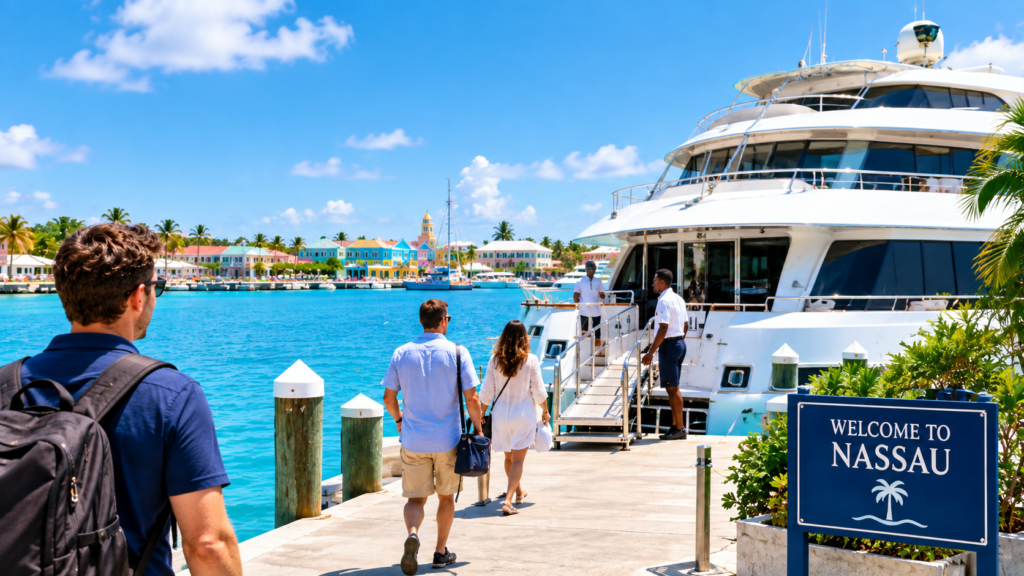
If you planned your Bahamas yacht trip using last year’s numbers, it’s worth taking a second look, because some of them no longer hold. On April 1, 2026, the rules for bringing a boat and its guests into the country changed, and the people most likely to get caught out are the ones who rarely plan for this sort of thing: the owner adding four friends to the manifest for a week, the captain working from the old fee sheet, or the guest who flies into Nassau expecting to step off the plane and straight onto the boat.
The Bahamas cruising permit 2026 update brought in a new fee structure and kept the per-guest passenger tax that tends to catch larger groups. It also left one thing exactly as it was, which is that getting from the airport to the dock still needs a plan rather than being something you can take for granted. Let’s walk through all three in the order you’re likely to run into them when you have guests joining a yacht in Nassau.
What Changed on April 1, 2026
Let’s start with the regulation itself, since everything else about budgeting for a guest-heavy trip follows from it.
The fees introduced in 2025 drew a lot of criticism, and many people blamed them for cruising yachts giving the Bahamas a miss. The government responded by revising the rules, and the new version came into force on April 1, 2026. The biggest change is in how the permits are structured. The old approach has been replaced with a three-tier temporary cruising permit system, with 30-day, six-month and twelve-month options, and entry now costs less for a lot of vessels, especially boats under 50 feet.
Here’s how the new Bahamas boating fees for temporary cruising permits break down, based on the April 2026 regulation as reported across marine industry sources.
| Permit Duration | Vessel Size | Fee | Re-entry |
| 30-day | 51 to 100 ft | $350 | No free re-entry |
| 30-day | Over 100 ft | $600 | No free re-entry |
| 6-month | 51 to 100 ft | $750 | One free re-entry |
| 6-month | Over 100 ft | $2,000 | One free re-entry |
| 12-month | 31 to 50 ft | $250 | Per permit terms |
| 12-month | 51 to 100 ft | $350 | Per permit terms |
| 12-month | Over 100 ft | $600 | Per permit terms |
A quick word of caution on these numbers. They come from marine industry reporting on the April 2026 regulation rather than from one official schedule, and the fee tables you’ll find from different sources don’t always match exactly. Before you travel, check the fee for your vessel size and permit length on the official Bahamas Customs Click2Clear system, because planning around an out-of-date figure is exactly the mistake you’re trying to avoid here.
The Passenger Tax That Catches Out Guest Groups
If you’re bringing people aboard, this is the part that turns your guest list into a line on the budget, and it’s really the reason this post exists.
On top of the cruising permit fee, there’s also the passenger tax Bahamas Customs charges on vessels carrying more than three guests. The 2026 sources put it at $30 for each additional passenger, and it applies to every passenger aged six or over who isn’t an ordinary resident of the Bahamas, once you go past the first three.
Here’s how that works out on a trip with a full guest list. The tax starts with the fourth qualifying passenger, so if you’re planning a week with eight guests aboard, you’ll be paying it on five of them. That’s a real number, and you’d much rather have it in the budget than discover it at clearance. The good news is that the passenger tax receipt you’re given on entry exempts those guests from paying again when they leave, so it’s a one-time arrival charge rather than a round-trip one.
There’s one thing to keep in mind about the figure itself. The 2026 marine industry sources consistently quote $30 per additional passenger, while an older Bahamas Customs page still lists $20. The $30 figure lines up with the current regulation, but since this is money your captain actually hands over at clearance, confirm the exact amount through Click2Clear or your marina’s clearance agent at the time of travel rather than relying on any published guide, this one included.
What Stayed the Same
Not everything changed, and knowing what stayed put saves you from planning around changes that never actually happened.
A few things came through the April 2026 revision untouched. The tender policy is the same as before, so if your tender is over 25 feet, there’s a $500 fee covering a period of up to twelve months, whether it’s kept aboard or towed. Fishing permits are still separate from the cruising permit and are no longer bundled in with it. They’re only valid for 30 days, however long your cruising permit runs, which means you’ll need to renew them every 30 days. The AIS requirement hasn’t changed either: any vessel over 50 feet has to keep its Automatic Identification System switched on at all times in Bahamian waters, and not doing so carries a $1,000 fine.
There’s one change worth pointing out if you tend to anchor rather than berth. Anchoring fees have been amended so they only apply if your vessel actually anchors, rather than kicking in simply because you’ve entered the Bahamas, and they don’t apply at all if you’re staying in a marina. So if your guest trip is based at a Nassau marina, the anchoring fee generally won’t come into it, which keeps the budget that bit simpler.
The Clearance Sequence Before Guests Step Ashore
Before any guest sets foot on the dock, and before the airport pickup even comes into the picture, the vessel has to clear. That step comes first, and everything else waits on it.
To enter, private vessels submit their forms digitally and complete online pleasure vessel clearance through the Click2Clear system, then clear Customs and Immigration at the nearest designated port of entry. When you arrive, you fly the yellow quarantine flag, and only the captain can leave the boat until it’s been cleared. Everyone aboard needs proof of citizenship, and US citizens need to show a passport.
If your guests are already aboard when you arrive, the practical upshot is that nobody gets off until clearance is done, so your arrival time and the clearance itself are the first things to plan around. If your guests are flying in to meet a boat that’s already in Nassau, it works differently, and their route runs through the airport rather than the quarantine flag.
Several marinas around Nassau are designated ports of entry with customs and immigration on site, so clearance can be handled right at the dock without a trip elsewhere. If your boat is berthed at one of these, clearance becomes part of the marina’s service, and your attention can shift to the guests arriving by air.
Guests Flying In: Getting From the Airport to the Dock
When guests are joining a yacht that’s already in Nassau, their journey starts at the airport, and a yacht guest transfer in Nassau has a few details that are worth sorting out ahead of time rather than improvising on the day.
Guests fly into Lynden Pindling International Airport (NAS) on the western side of New Providence. They go through immigration, collect their bags and clear customs, which usually takes 30 to 60 minutes depending on how many flights have landed at once. Only after that do they reach ground transport for the drive to the marina, and how long the drive takes depends on where the boat is.
The three main superyacht bases are in quite different spots relative to the airport, and the drive times reflect that:
- Lyford Cay, on the western tip, is the closest at roughly 10 to 15 minutes. It’s on the same side of the island as the airport and sits behind a guarded gate, so the guest needs to be expected.
- Albany, on the southwest coast, is a short run of around 15 to 20 minutes that doesn’t go through downtown.
- Hurricane Hole, on Paradise Island, is the longest at 25 to 35 minutes, since the route crosses the island and a toll bridge, and it can stretch further on busy cruise days.
For guests arriving to join a boat, the usual approach is a private car booked in advance against their flight number. Guests joining a yacht rarely travel light, they’re often arriving on the boat’s schedule rather than their own, and after a long travel day nobody wants to be negotiating a ride at the kerb. The vehicle should be sized to the group’s luggage rather than the number of people, which is where things often go wrong when guests bring a week’s worth of bags for a boat trip.
Simon’s Transports has been handling this kind of yacht guest and crew work across Nassau, Paradise Island and the western marinas for over thirty years, with a fleet that covers sedans, SUVs, sprinters and buses. If you’re coordinating several guest arrivals, that gives you one point of contact who can match the right vehicle to each arrival, and who understands that at a gated marina like Lyford Cay, the guest has to be expected at the gate as well as met at the airport.
Coordinating Guests, the Manifest and the Pickup
When you’re bringing guests aboard, the paperwork and the pickup are tied together, and handling them side by side is the easiest way to avoid gaps.
The passenger tax is worked out from the manifest, so who’s aboard and who’s joining is as much a transport question as an immigration one. A guest who flies in to join the boat shows up at both ends: they count toward the passenger tax once they board, and they need an airport-to-dock transfer to get there in the first place. In other words, planning your guest list is also planning your arrivals.
A few things to keep in mind if you have guests joining you in Nassau:
- Lock in the guest list early, since it drives both your passenger tax budget and the number of airport pickups you’ll need.
- Share each guest’s flight number rather than an arrival time, so the driver can keep track of any delays.
- Size each vehicle to the guest’s luggage, and note whether they’re arriving at the main terminal or the private FBO.
- If the marina is gated, make sure each guest is cleared at the gate as well as met at the airport.
- If several guests are landing over the course of a day, coordinate them all through one operator instead of booking each one separately.
The bottom line is that a guest joining a yacht in Nassau is a manifest entry, a tax line and an airport pickup all at once. Owners and captains who plan all three together tend to have a much smoother arrival than those who treat them as separate problems.
Timing and Season for a Guest Trip
When your guests join makes a real difference to the trip, and the season has a bearing on both the fees and the logistics.
The winter high season, running from late autumn through spring, brings settled weather and the busiest time on the water, which is why most guest trips fall in those months. Summer is quieter, but hurricane season officially runs from June through November, with its historical peak in late summer and early autumn, so it’s a genuine scheduling factor for a guest trip, particularly if any part of the plan is prepaid and non-refundable.
The new permit structure fits in nicely with trip timing. The 30-day cruising permit, one of the options introduced in April 2026, suits an owner planning a single guest-season trip rather than a full year of cruising, and it’s priced to match. If you’re weighing the 30-day permit against the six-month or twelve-month options, base the decision on how many times the boat will enter the country and how long it’ll stay, because the re-entry allowances differ between tiers.
Cruise ship days can slow down the airport-to-dock run for guests heading to Paradise Island, since that route goes through downtown, while guests heading to the western marinas are largely unaffected. If your guests are arriving on a heavy cruise day and the boat is at Hurricane Hole, allow some extra time. The Junkanoo parades in late December, held across the islands every year, can also close or divert roads downtown, so if guests are arriving around a major event, check the current dates and any road closures with the official organisers.
A Pre-Trip Checklist for Owners Bringing Guests
Before a Nassau guest trip, running through this list will cover the fees, the tax and the arrivals in one go.
- Check the current cruising permit fee for your vessel size and permit length through Click2Clear, not an old fee schedule.
- Pick your permit tier (30-day, six-month or twelve-month) based on how many entries you’ll make and how long you’ll stay.
- Budget the passenger tax for every guest beyond the first three, using the current per-head figure confirmed at the time of travel.
- Remember that the passenger tax receipt exempts those guests from the departure charge.
- Check whether the tender, fishing or AIS rules apply to your vessel, since those haven’t changed.
- Confirm that your marina is a designated port of entry with clearance at the dock.
- Finalise the guest list early, as it drives both the tax and the number of airport pickups.
- Book each guest’s airport transfer against their flight number, with a vehicle sized to their luggage.
- If the marina is gated, make sure each guest is expected at the gate.
- Coordinate multiple guest arrivals through one operator.
Work through that list and your guest trip stops being a string of separate surprises, like a fee that changed, a tax nobody budgeted for or a guest stuck at the airport, and becomes one plan built on the current rules.
Frequently Asked Questions
How much is the passenger tax for guests on a yacht in the Bahamas?
The passenger tax applies to vessels carrying more than three guests. The current figure is $30 for each additional passenger aged six or over who isn't an ordinary resident of the Bahamas, counted above the first three. It's assessed on the manifest at entry, so if you bring eight guests, you'll pay it on five of them. The receipt you get on arrival exempts those guests from paying again when they leave. Since 2026 sources list the tax at $30 while an older government page shows $20, confirm the current amount when you travel.
Do guests joining a yacht need to clear customs and immigration?
Yes. Everyone aboard a vessel needs proof of citizenship, and US citizens need to present a passport. The vessel has to clear Customs and Immigration at a designated port of entry, flying the yellow quarantine flag until clearance is complete, and only the captain can leave the boat until then. Guests flying into Nassau to join a boat clear immigration at the airport like any other air passenger, then travel on to the marina. Several marinas around Nassau are designated ports of entry and can handle vessel clearance on site.
How do guests get from Nassau airport to the marina?
After clearing immigration and customs at Lynden Pindling International Airport, which takes 30 to 60 minutes, guests travel to the marina by road. How long that takes depends on the marina: Lyford Cay on the western tip is roughly 10 to 15 minutes away, Albany on the southwest coast around 15 to 20, and Hurricane Hole on Paradise Island 25 to 35 minutes, including a bridge crossing. The usual approach is a private car booked in advance against the guest's flight number and sized to their luggage rather than the number of people. If the marina is gated, the guest also needs to be expected at the gate.
Which cruising permit duration is best for a guest trip?
That depends on how many times the vessel will enter the Bahamas and how long it'll stay. The 30-day temporary permit introduced in April 2026 works well for a single guest-season trip and costs less than the longer options, though it doesn't include a free re-entry. The six-month permit comes with one free re-entry, and the twelve-month permit suits vessels cruising throughout the year. If you're planning several entries over a longer period, it's also worth looking at the Frequent Digital Cruising Card, a two-year alternative. Either way, check the current fees and re-entry terms through Click2Clear before you decide.