

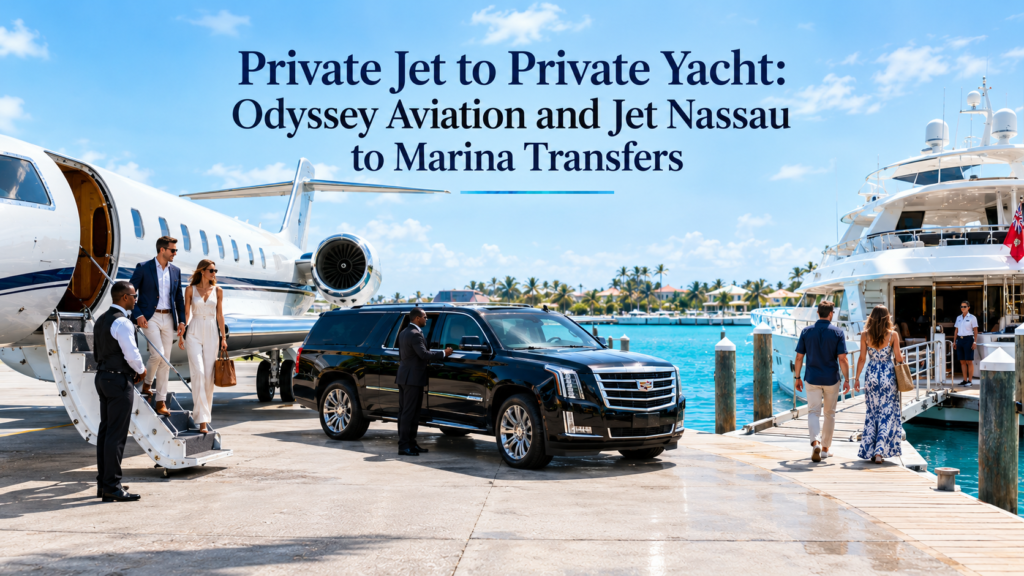
The arrival that ends on a yacht usually begins on a jet, and in Nassau the stretch between the two is shorter and smoother than most people assume, if it is set up properly. You do not come through the main terminal. You land at a private aviation terminal, clear customs in a quiet room rather than a queue, and a car takes you to the marina where the boat is waiting. The whole thing can take minutes. The piece that makes it work is the ground leg in the middle, the handoff from the FBO to the dock, and that is what this guide is about.
The Two FBOs at Nassau
Start with where a private jet actually lands. Nassau’s Lynden Pindling International Airport (MYNN) has two fixed base operators, the private aviation terminals that handle private and charter aircraft separately from the commercial side: Odyssey Aviation and JET Nassau. Both are listed among the airport’s private flight services, and both exist to move private travellers through arrival quickly and discreetly.
An Odyssey Aviation transfer or a JET Nassau transfer does not mean the main arrivals hall. It means a dedicated terminal where the aircraft is met, the passengers are escorted, and the formalities happen on a different scale from a commercial flight. For a traveller heading to a yacht, that difference is the entire point of flying private in the first place, and it carries straight through to how fast you reach the water.
Why an FBO Arrival Is Faster
Understanding why the FBO route saves time explains how to plan the transfer.
When you arrive on a commercial flight, you clear immigration and customs in the main terminal alongside everyone else, which on a busy day is a long queue. An FBO arrival is different. Odyssey Aviation’s Nassau facility has customs and immigration on site, and the FBO escorts arriving passengers through the clearance process. You are cleared in the private terminal, not the public one.
That compresses the arrival from the better part of an hour to a fraction of it. There is no baggage carousel to wait at, no customs-hall crowd, and no walk through a terminal with your bags. You step off the aircraft, you are met, you clear, and you are ready for the ground transfer. For a yacht guest, this is the version of arriving in the Bahamas that matches the rest of the trip.
The Ground Leg: FBO to Marina
Here is the part that actually needs arranging, because the FBO gets you cleared and the yacht is waiting, but something has to cover the distance between them.
A private jet to yacht Bahamas transfer has a ground segment in the middle: a car from the FBO to the marina. It is short, but it is the link that ties the aircraft to the vessel, and it is where an otherwise seamless arrival can stall if nobody arranged it. The drive depends on which marina the boat is berthed at, and Nassau’s main superyacht marinas sit in different places relative to the airport.
| Marina | Location | Drive from the FBO | Notes |
| Lyford Cay | Western tip of New Providence | Short, roughly 10-15 min | Same side as the airport; gated community |
| Albany | Southwest coast | Short, roughly 15-20 min | Same side as the airport; no downtown crossing |
| Hurricane Hole | Paradise Island | Longer, roughly 25-35 min | Crosses the island and a bridge with a toll |
Two of the three sit on the western side of the island, the same side as the airport, so the drive from the FBO is quick and does not cross downtown. Hurricane Hole on Paradise Island is the longer run, across the island and over a bridge. Knowing which applies to your vessel is the first thing to settle, because it sets the timing of the whole handoff.
Coordinating the Handoff
The reason this transfer needs a plan rather than a taxi is that three moving parts have to line up: the aircraft’s arrival, the FBO clearance, and the car to the marina. When they are coordinated, the car is waiting as you clear, and you are at the dock before the crew has finished prepping. When they are not, you are cleared and standing at a private terminal with no ride, which is a strange place to be after flying private.
A proper VIP marina transfer treats the ground leg as part of the arrival chain, not an afterthought. The car is booked against the flight, the driver knows which FBO and which marina, and the timing is built around the clearance rather than guessed. For a gated marina like Lyford Cay, there is an extra step: the guest has to be expected at the community gate as well as met at the FBO, so the clearance at the gate and the clearance at the terminal both need arranging.
This is the practical role a ground operator plays in a jet-to-yacht arrival. Simon’s Transports runs this kind of FBO transfer Nassau work, the car from Odyssey Aviation or JET Nassau to the marina, coordinated against the flight and sized to the party and its luggage, which for a private arrival matters as the single link that keeps the aircraft-to-vessel chain from breaking in the middle.
What the FBO Handles, and What It Doesn’t
Knowing the split keeps you from either duplicating a service or assuming one exists that doesn’t.
The FBO handles the aviation side and the arrival formalities: meeting the aircraft, arranging landing permits, fuelling, and escorting passengers through the on-site customs and immigration. That clearance is genuinely done at the FBO, which is the time-saving core of the whole thing.
What the FBO does not inherently cover is the onward ground transport to a marina across the island. That is a separate arrangement, and it is the one a yacht guest most needs handled, since the boat is not at the airport. Treating the ground leg as its own booking, coordinated with the FBO’s timing, is what turns two separate services into one smooth arrival.
Sizing the Transfer
A private arrival is not always one or two people, and the vehicle has to match the reality.
Private jets carry parties, and those parties bring luggage, sometimes a lot of it, for a stay on a yacht. The common error is sizing the car to the headcount rather than the bags. A couple joining a boat for a week arrives with more than a couple’s worth of luggage, and a larger group needs a vehicle that takes everyone and their cases in one trip rather than splitting across cars at the FBO.
For groups, an SUV, a sprinter, or a larger vehicle keeps the party together, which matters more on a private arrival than on a commercial one, since the whole appeal is not fragmenting the experience at the final step. Give the ground operator the party size and the luggage when you book, not just the number of passengers.
The Reverse: Yacht to Jet
The same chain runs the other way on departure, and it is worth planning with the same care.
Leaving, the car collects from the marina and returns you to the FBO, where the private terminal handles your departure. The timing is gentler than a commercial departure, since you are not working against a three-hour check-in and a public security queue, but the ground leg still has to be arranged, and for a gated marina the gate still has to expect the car. Booking the return at the same time as the arrival keeps the departure as smooth as the arrival, and means the car is confirmed rather than scrambled for on the morning you leave.
Timing and the Island
A few practical realities shape the ground leg, even on a private arrival.
The marinas on the western side of the island, Lyford Cay and Albany, have FBO-to-dock drives that stay clear of downtown, so they hold their timing well regardless of what else is happening in Nassau. The run to Hurricane Hole on Paradise Island crosses the island and the bridge, so it is the one affected by downtown congestion on heavy cruise days. If the vessel is at Hurricane Hole and the arrival is timed tightly, that is worth factoring in.
The winter high season, late autumn through spring, is the busiest period on the water and the one when private arrivals cluster, so arranging the ground transfer ahead matters more then. Summer is quieter, and hurricane season officially runs June through November, which for a yacht is a scheduling consideration in its own right.
A Pre-Arrival Checklist
For a jet-to-yacht arrival in Nassau, settling these in advance keeps the handoff clean.
- Confirm which FBO the aircraft is using, Odyssey Aviation or JET Nassau.
- Confirm which marina the vessel is berthed at, since it sets the drive and the timing.
- Arrange the ground transfer against the flight, so the car is waiting as you clear.
- Size the vehicle to the party’s luggage, not just the headcount.
- For a gated marina like Lyford Cay, ensure the guest and the car are expected at the gate.
- Coordinate the FBO clearance timing with the car, so the two line up.
- Book the return leg, marina to FBO, at the same time.
- Use a ground operator who knows both FBOs and the marinas, so the chain is held by one point of contact.
That list turns a private jet to private yacht arrival from three separate services into one coordinated chain, which is the whole reason for arriving this way.
Frequently Asked Questions
How does a private jet to yacht transfer work in the Bahamas?
You land at an FBO, Odyssey Aviation or JET Nassau, where the aircraft is met and you are escorted through on-site customs and immigration, which is far quicker than the commercial terminal. A pre-arranged car then takes you from the FBO to the marina where the yacht is berthed. The ground leg is short but essential, since the boat is not at the airport, and coordinating it against the flight is what keeps the arrival seamless. The same chain runs in reverse on departure.
How far is the marina from the Nassau FBO?
It depends on the marina. Lyford Cay on the western tip and Albany on the southwest coast are short drives, roughly 10 to 20 minutes, on the same side of the island as the airport with no downtown crossing. Hurricane Hole on Paradise Island is longer, roughly 25 to 35 minutes, crossing the island and a bridge with a toll. Confirming which marina your vessel is at sets the timing for the whole FBO-to-dock transfer.
Do private jet passengers clear customs at the FBO?
Yes. At Nassau, the FBOs have customs and immigration available, and Odyssey Aviation's facility includes on-site clearance with a passenger escort through the process. This is the main reason an FBO arrival is so much faster than a commercial one, there is no main-terminal queue, no baggage carousel, and no customs-hall crowd. You clear in the private terminal and move straight to your ground transfer. Confirm current arrangements with your FBO and handler before travelling.
Should I book the ground transfer and the return together?
Yes. Booking the marina transfer and the return to the FBO at the same time keeps both legs confirmed and coordinated, rather than arranging the departure in a hurry on the day you leave. The return runs the same chain in reverse, car from the marina to the FBO, and for a gated marina the gate still needs to expect the car. A single ground operator holding both legs, coordinated against your flights, is the cleanest way to keep the whole jet-to-yacht chain smooth in both directions.